

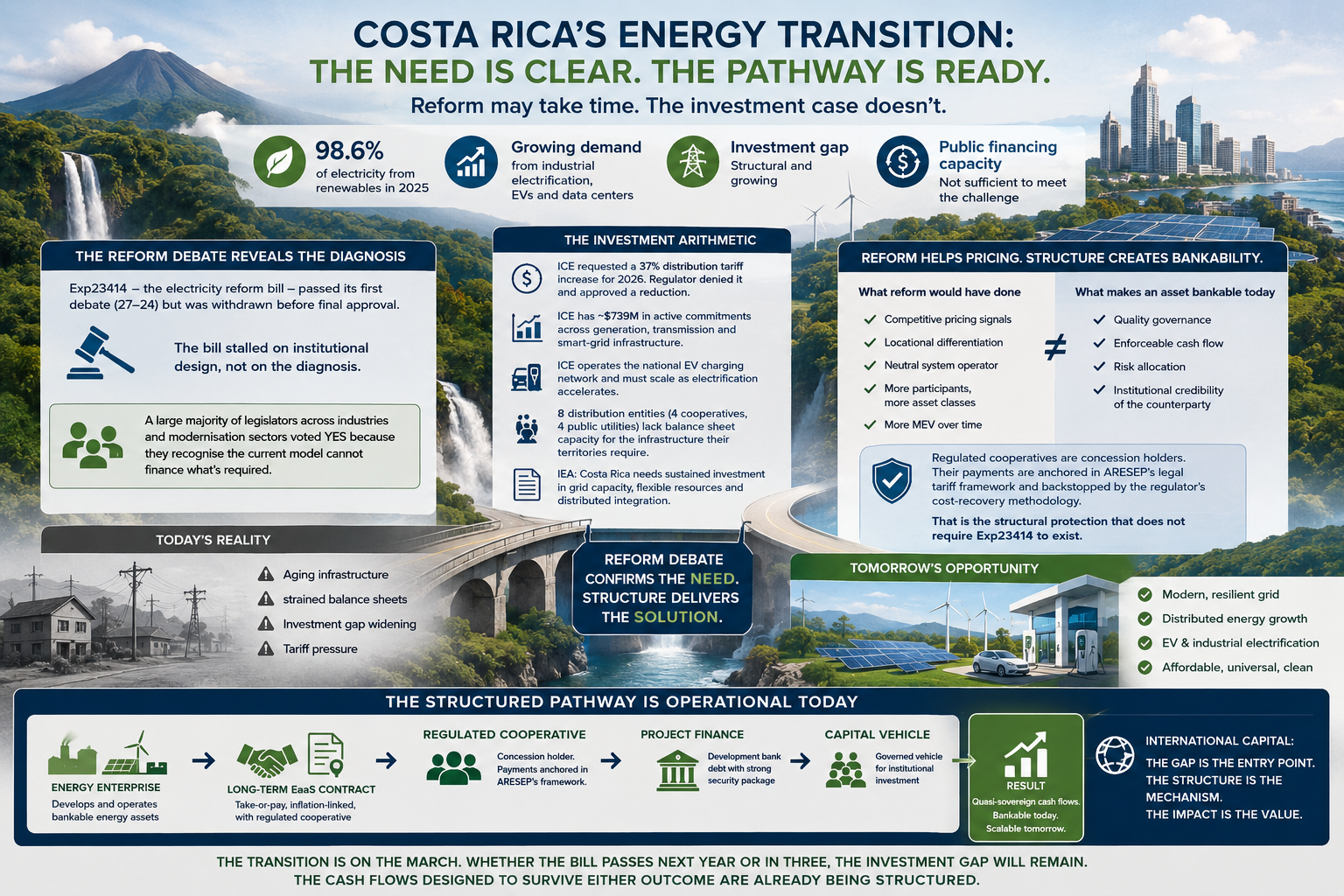
Costa Rica's electricity reform bill was withdrawn from Congress in May 2026 — hours after passing its first legislative debate with 27 votes in favour and 24 against.
The bill needed 38 votes for final approval. The government didn't have them.
To a casual observer, this looks like a setback for Costa Rica's energy transition. It isn't. Read correctly, the vote count and the investment arithmetic behind it tell a more interesting story.
What the reform debate actually reveals
The bill — formally the Ley de Armonización del Sistema Eléctrico Nacional — proposed creating a neutral system operator (ECOSEN), opening a national electricity market, and requiring distribution companies to contract 90% of their demand through competitive auctions.
It was controversial because it threatened the institutional structure that has made Costa Rica's grid one of the cleanest in the world: a vertically integrated public utility, eight rural electric cooperatives, and a regulated tariff that cross-subsidizes universal service.
But the debate revealed something that matters more than the legislative outcome: a large majority of legislators — representing industry, technology sector, and energy modernisation constituencies — voted yes precisely because they recognise that the current model cannot finance what Costa Rica's energy trajectory requires.
The reform bill stalled on institutional design, not on the diagnosis.
The diagnosis is not in dispute.
The investment arithmetic
Costa Rica generated 98.6% of its electricity from renewables in 2025. That is not a problem. It is the foundation of a serious structural constraint.
The electricity system needs to grow and modernise at the same time it needs to remain affordable and universal. Those two requirements are increasingly in tension.
ICE — the public utility — requested a 37% increase in its distribution tariff for 2026, citing operating costs, debt service, and investment requirements. The regulator denied it and approved a reduction instead, driven by a temporary normalisation of variable generation costs.
The underlying investment pressure did not disappear.
ICE currently has active commitments of approximately $739 million across generation, transmission, and smart-grid infrastructure. It also operates the country's EV charging network and must scale it as vehicle electrification accelerates. Costa Rica's eight distribution entities — four electric cooperatives and four public utilities — hold the concession territories but lack the balance sheet capacity to finance the distributed energy infrastructure those territories require.
The IEA's Costa Rica energy profile describes a country that needs sustained investment in grid capacity, flexible resources, and distributed integration to meet industrial electrification, EV charging, and net-zero trajectory targets.
The public financing capacity to meet that profile is not sufficient.
That is the signal.
What structured private capital does that reform cannot
A market reform like Exp23414 would have introduced competitive pricing signals, locational differentiation, and a neutral operator — making it easier, over time, for capital to find and price the value of energy assets in Costa Rica.
But reform is not what structures a bankable asset today.
What makes an energy contract bankable is not the presence of a market. It is the quality of governance, the enforceability of the cash flow, the risk allocation, and the institutional credibility of the counterparty.
Costa Rica's cooperative electric distributors are regulated concession holders. Their obligation to pay for energy services is anchored in a regulatory tariff framework that ARESEP is legally required to maintain. When a structured vehicle — a governed Energy Enterprise with a long-term EaaS contract, project-finance debt, and a capital vehicle — delivers energy to one of these cooperatives, the resulting cash flow has quasi-sovereign characteristics. The counterparty is not a commercial buyer. It is a regulated institution whose payments are ultimately backstopped by the cost-recovery methodology of the state regulator.
That is the structural protection that does not require Exp23414 to exist.
The reform, if and when it passes in some future legislative cycle, will improve the pricing signal and expand the MEV available to well-structured assets. The cash-flow architecture that makes those assets bankable today is already available.
The case for international capital
The investment gap in Costa Rica's electricity system is not cyclical. It is structural and growing, driven by electrification demand, aging cooperative infrastructure, and an ICE balance sheet that cannot absorb the investment load without private capital participation.
The structured pathway — long-term energy contracts with regulated cooperatives as counterparties, project finance with a development bank, a capital vehicle eligible for institutional investment — is operational today. It does not depend on legislative reform to produce bankable cash flows.
What reform adds, over time, is the depth of the opportunity: more transparent pricing, more participants, more asset classes.
The transition is already on the march.
The investment gap is the entry point. The structured contract is the mechanism. The regulated cooperative is the anchor. The capital vehicle is the pathway toward scale.
For international capital evaluating Costa Rica's energy transition: the reform debate confirms the need, not just the opportunity. Whether the bill passes next year or in three years, the gap it was designed to address will still be there. And the cash flows designed to survive either outcome are already being structured.